Kalaignar Magalir Urimai Thogai Eligibility Checker
Use our interactive evaluation tool to instantly check if your household qualifies for the Tamil Nadu government's Kalaignar Magalir Urimai Thogai (KMUT) scheme, which grants a monthly basic income support of ₹1,000 directly via Direct Benefit Transfer (DBT).
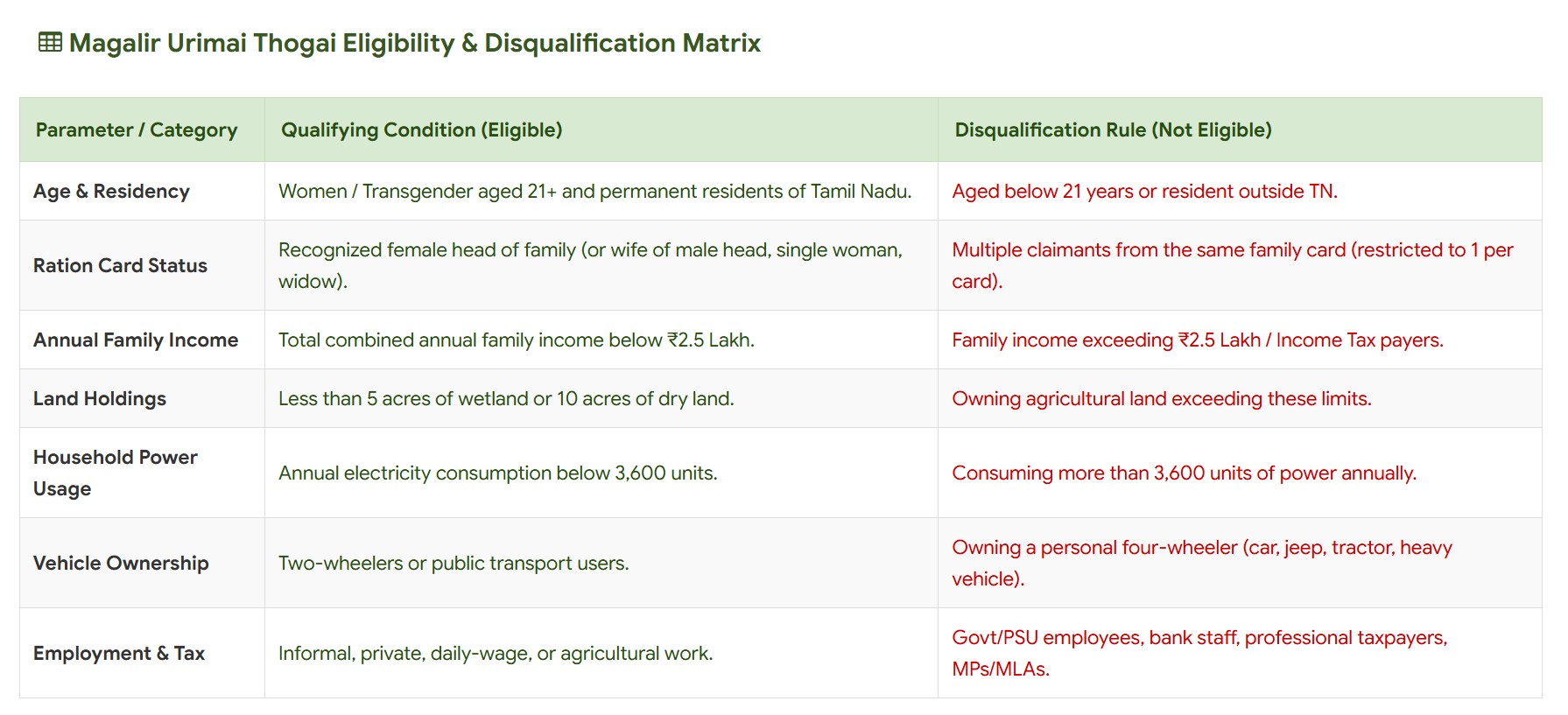
Magalir Urimai Thogai Eligibility & Disqualification Matrix
| Parameter / Category | Qualifying Condition (Eligible) | Disqualification Rule (Not Eligible) |
|---|---|---|
| Age & Residency | Women / Transgender aged 21+ and permanent residents of Tamil Nadu. | Aged below 21 years or resident outside TN. |
| Ration Card Status | Recognized female head of family (or wife of male head, single woman, widow). | Multiple claimants from the same family card (restricted to 1 per card). |
| Annual Family Income | Total combined annual family income below ₹2.5 Lakh. | Family income exceeding ₹2.5 Lakh / Income Tax payers. |
| Land Holdings | Less than 5 acres of wetland or 10 acres of dry land. | Owning agricultural land exceeding these limits. |
| Household Power Usage | Annual electricity consumption below 3,600 units. | Consuming more than 3,600 units of power annually. |
| Vehicle Ownership | Two-wheelers or public transport users. | Owning a personal four-wheeler (car, jeep, tractor, heavy vehicle). |
| Employment & Tax | Informal, private, daily-wage, or agricultural work. | Govt/PSU employees, bank staff, professional taxpayers, MPs/MLAs. |
Comprehensive Guide to Kalaignar Magalir Urimai Thogai (KMUT)
Launched by the Government of Tamil Nadu, the Kalaignar Magalir Urimai Thogai Thittam is a landmark social welfare initiative designed to honor household labor performed by women, fostering financial autonomy and economic independence. Eligible beneficiaries receive a regular monthly transfer of ₹1,000 credited straight to their bank accounts.
Key Guidelines & Eligibility Norms
- Age and Residency: Applicants must be permanent residents of Tamil Nadu and have completed 21 years of age.
- Family Head Rule: The woman designated as the head of the family on the digital ration card is prioritized. If a male is listed as head, his wife is treated as the eligible nominee. Destitute widows and single women heads are fully accommodated.
- Income Thresholds: Total annual family income from all sources must not exceed ₹2.5 Lakh.
- Asset and Utility Limits: Families must not own personal four-wheelers, must hold agricultural land under 5 acres of wetland or 10 acres of dry land, and must maintain annual household electricity consumption below 3,600 units.
Frequently Asked Questions (FAQs)
1. What is the monthly monetary benefit provided under Kalaignar Magalir Urimai Thogai?
Eligible women receive ₹1,000 per month, deposited directly into their Aadhaar-linked bank accounts via Direct Benefit Transfer (DBT).
2. Who is considered the head of the family if the ration card lists a male member?
According to scheme guidelines, if the ration card names a male member as the head, his wife is automatically considered the eligible female head for the application.
3. What is the maximum annual family income limit to qualify?
The total annual family income from all combined employment, business, or wage sources must be below ₹2.5 Lakh.
4. Are families working in government jobs eligible for the scheme?
No. Wives or dependents of regular Central or State Government employees, public sector undertakings (PSUs), banks, and cooperative society staff are excluded.
5. Can income tax payers apply for Magalir Urimai Thogai?
No, individuals or families filing income tax returns or professional tax assessments are strictly ineligible.
6. What are the landholding restrictions for farming families?
Farming families owning more than 5 acres of wetland or 10 acres of dry land do not qualify for the financial assistance program.
7. Does owning a car disqualify a family from receiving the grant?
Yes. Families owning personal four-wheelers such as cars, jeeps, or commercial tractors are excluded from the scheme.
8. What is the electricity consumption limit for households?
The household's annual electricity consumption must remain below 3,600 units to meet the economic threshold.
9. Can multiple women from the same ration card apply?
No. The benefit is restricted to only one eligible woman beneficiary per family ration card unit.
10. What documents are required to apply for the scheme?
Applicants need their Aadhaar card, Tamil Nadu family ration card, Aadhaar-linked bank account passbook, and supporting residence or income declarations.
11. How can beneficiaries check their application status or payment credit?
Applicants can track status updates online via the official KMUT portal (kmut.tn.gov.in) or through local e-Sevai centres.
12. Are women receiving other social security pensions eligible?
Generally, families already receiving major state welfare pensions (like regular old-age or destitute pensions) are excluded to ensure broader distribution, with specific exceptions for disability allowances.